A custom radio fascia for the Opel Vivaro - developed from a scan of the dashboard and modeled in CAD. The image shows the finished part installed around the radio.
Historic lamp design preserved digitally
Lamps from Frederiksberg Hotel in Copenhagen were digitized and reconstructed in CAD with historical preservation and possible remanufacturing in mind.
Overview of an industrial facility
The machine and associated equipment were modeled digitally so that their geometry and relative positioning can be examined from multiple angles.
SLA printing with complex shapes and fine details
The project for chocolate mold inserts includes curved surfaces, geometric patterns, and small details. Shown here are the physical SLA prints from the project.
This is a different starting point than a technical spare part: surface, shape, and detail reproduction are central. The material, post-processing, and subsequent use are determined as part of the assignment.
3D printing with the material and task at the center
We help with individual parts, prototypes, and production runs. The material and printing method are selected based on load, temperature, surroundings, and the desired finish.
A detailed model and a functional bracket have different requirements. Therefore, we also assess orientation, wall thicknesses, and assembly when preparing the model for manufacturing.
Even the small parts deserve a good model
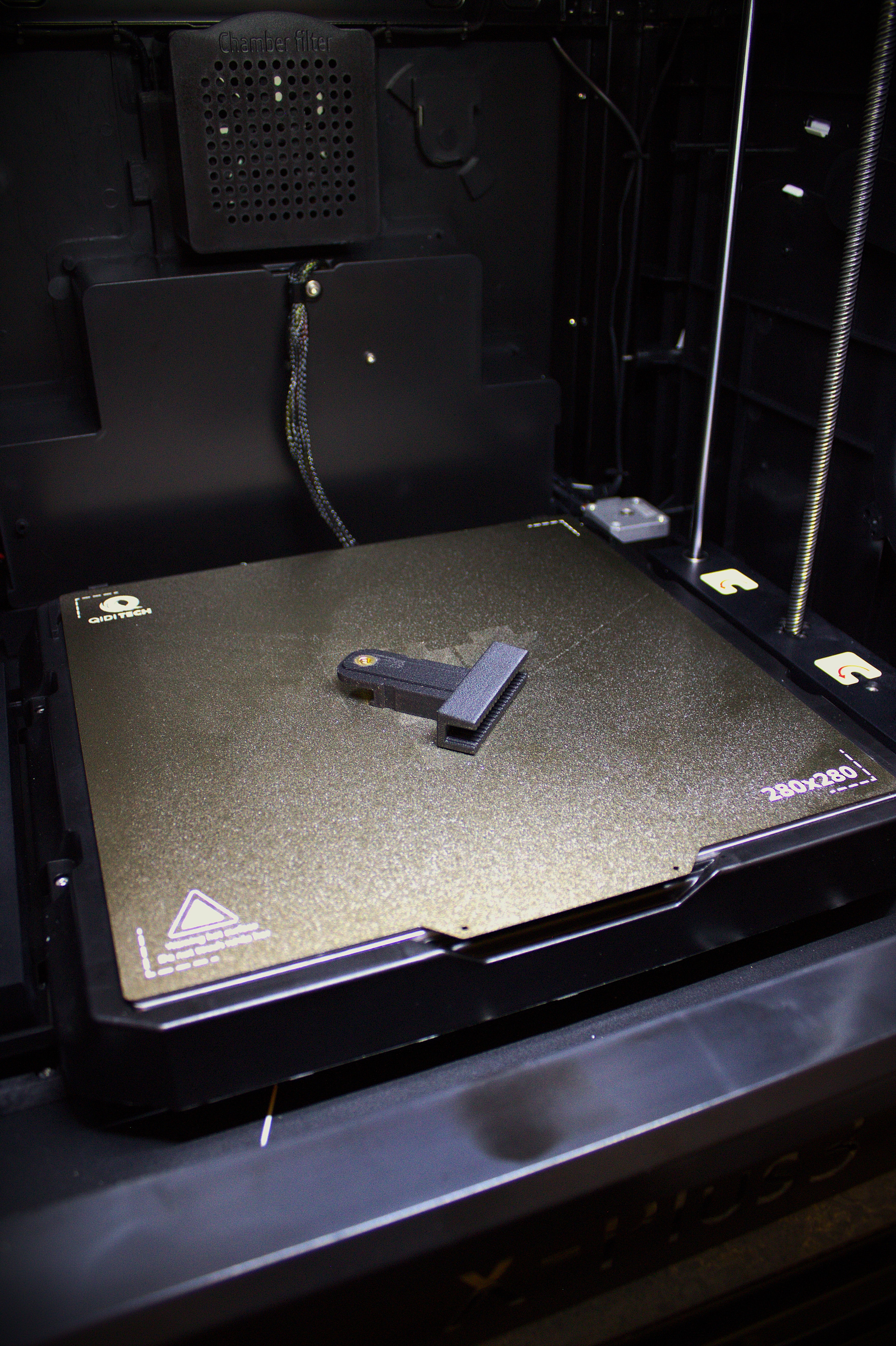
A clamp was scanned and reconstructed as a digital model. Small contact surfaces, curves, and details require just as much thought as large structures.
Good 3D design is about both recreating the shape and understanding how the part is meant to function - as a basis for customization, prototypes, and manufacturing.
FROM PROTOTYPE TO USABLE PART
Different tasks. Different materials.
The materials must suit what the part needs to do. Here are five customer projects in ABS-GF25, ASA, PETG-CF15, PLA, and PC/ABS - from an early design model to custom parts that form part of a larger solution.
Send photos, a sketch, or a 3D file. Describe the function, approximate dimensions, quantity, and your deadline. We will clarify the scope and price.
2. Design and testing
We develop or adapt the model. If needed, a prototype is used to check the fit and function before the next step is agreed upon.
3. Manufacturing and delivery
The agreed solution is produced and delivered. Digital files, post-processing, and any reordering are clarified as part of the assignment.
What ourcustomers say
René
Focus on quality. A company that puts the customer's needs first and takes the time to achieve perfection. Thank you for the excellent work and beautiful result.
Brian
Here you get first-class service
Simon
Absolutely fantastic service from Toke at 3D-FixIt. Great guidance and excellent solutions that met my specific needs.
Asbjørn
Fast and precise production based on broken pieces, perfect fit.
Thomas
Excellent service. You come with a task, and he simply solves it. This is the second time we’ve used 3D-FixIt, and we’re extremely satisfied!
Yes. A brief description, photos, and the most important measurements are a good starting point. In particular, tell us what the part needs to do and what it needs to fit with. We will then determine what design work is required.
How much do 3D design and 3D printing cost?
The price depends on the design work, size, geometry, material, quantity, and finishing. A finished printable file requires a different level of effort than an idea that first needs to be constructed. We provide a specific quote for the agreed deliverable.
Can I print my own STL, STEP, or 3MF file?
Please send the file along with the desired size, quantity, and intended use. We will assess whether it is suitable for production and whether the geometry needs to be adjusted. STEP is useful for CAD work; STL and 3MF are often used for print preparation.
Can you manufacture a spare part that has been discontinued?
Often, an existing part, measurement, or assembly can be used as a reference. Wear, missing areas, and functional requirements determine how much needs to be reconstructed. An item can also be redesigned when a direct copy is not the best solution.
Which material should I choose?
Start with the application: load, heat, sunlight, moisture, and contact with other substances. Also tell us whether flexibility, appearance, or wear resistance is most important. We help choose the material based on the task rather than choosing solely by color or price.
Is 3D printing strong enough for functional parts?
That may be the case, but the strength depends on the material, design, printing direction, and load. Wall thicknesses and joints also matter a great deal. We assess the requirements and agree on relevant testing; an attractive surface alone does not demonstrate strength.
What is the difference between filament printing and resin printing?
Filament printing builds the object with melted plastic and is often used for functional parts and larger geometries. Resin printing cures liquid resin with light and may be suitable for fine details. The material's specific properties and post-processing determine what is suitable for the task.
Can I order one part or a small series?
Yes, we help with individual parts, prototypes, and series. Quantity, design, and material affect the cost. For repeat orders, it is beneficial to keep track of the approved model version and the agreed requirements.
How do we ensure that the part fits?
We agree on the critical dimensions and mating surfaces. Measurement or scanning can provide reference geometry, and a prototype can be used to test the part in the actual assembly. The necessary clearance and tolerances depend on both the manufacturing process and the application.
How quickly can the assignment be delivered?
It depends on whether the file is ready or needs to be designed and tested first. Printing time, material, quantity, and post-processing are also factors. Tell us your deadline from the outset so we can agree on a realistic delivery time.
Do I also get the digital drawings and models?
It is agreed in the quotation. A physical part, a print file, and an editable CAD deliverable are different deliverables. Tell us in advance if you need to use the model for further development, documentation, or manufacturing elsewhere.
When does 3D scanning make sense?
Scanning is useful when a physical shape is difficult to measure or when a new part needs to fit into an existing environment. A simple part can sometimes be designed more quickly from a few measurements. See our scanning examples and guide to reverse engineering.
What should I send to get a quote?
Send a description of the function, approximate dimensions, quantity, and desired deadline. Feel free to attach photos, a sketch, or an existing file. Provide critical dimensions, load, and surroundings if you know them; otherwise, we’ll clarify them together.
What you can expect from us
A solution to your assignment
We start with what the part needs to do. The shape, fit, material, and manufacturing method are selected based on the application.
Clear agreement on the process
We clarify the scope, price, and delivery before the work starts. You know what you’ll get - from scanning and CAD files to a prototype or finished part.
Direct dialogue along the way
You're talking with the person working on your assignment. We'll go over questions and adjustments together and agree on the next steps.
DRAWING, FILE OR PHYSICAL PART
What can we help you with?
Tell us about your idea, function, approximate dimensions, quantity, and desired deadline. Send images and files to info@3dfixit.dk, or start with a message here.
Call 30 14 31 03. We clarify the task and provide a quote for design, prototyping, and manufacturing as needed.
Loading form…
Choosing a selection results in a full page refresh.